September 29, 2026
Local SEO for Small Businesses in Ireland: A Beginner's Guide
Category: SEO
Want more local customers to find you on Google? Here's a plain-English guide to local SEO for Irish small businesses — from Google Business Profile to reviews, citations and local links.
Want more local customers to find you on Google? Here's a plain-English guide to local SEO for Irish small businesses — from Google Business Profile to reviews, citations and local links. No technical background required.
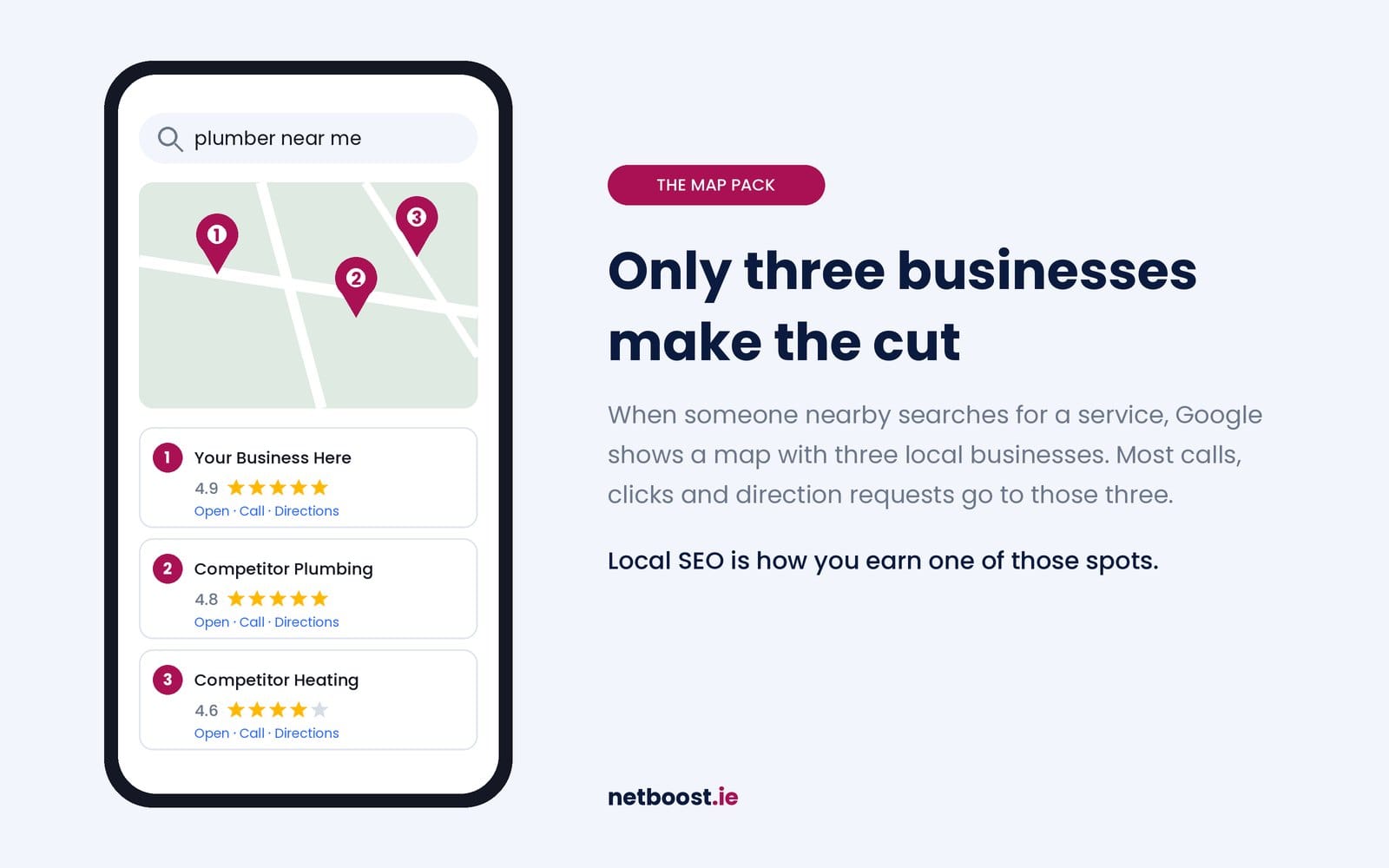
It's a wet Tuesday evening in Galway. Someone's boiler has just given up, and they type "plumber near me" into their phone. Google shows a map with three businesses pinned to it. They ring the first one with decent reviews — and the job is booked within two minutes.
The other plumbers in Galway might be excellent. Some may be cheaper, some may be closer. It doesn't matter — they weren't in those three spots.
That's local SEO in a nutshell. It isn't about ranking for the whole world. It's about showing up at the exact moment someone nearby needs what you sell — and for most Irish small businesses, that moment matters more than any other marketing you'll do. This guide walks through what local SEO is, how Google decides who shows up, and the practical steps you can take this week to get found by more local customers.
Before anything else: find out where you stand right now. Our free SEO audit gives you an instant check of your website's SEO health, so you know exactly which of the steps below will make the biggest difference for you.
What Is Local SEO, Exactly?
Local SEO is the work of making your business visible in location-based searches — things like "café Salthill", "accountant Athlone", "web design Galway", or simply "hairdresser near me".
These searches bring up two things: the map pack (the box of three businesses with a map) and the ordinary list of website results underneath. Local SEO helps you appear in both.
Regular SEO asks "how do I rank for this topic?" Local SEO asks "how do I rank for this topic, here?" — and that second question changes a lot about how you approach it.
How Google Decides Who Shows Up Locally
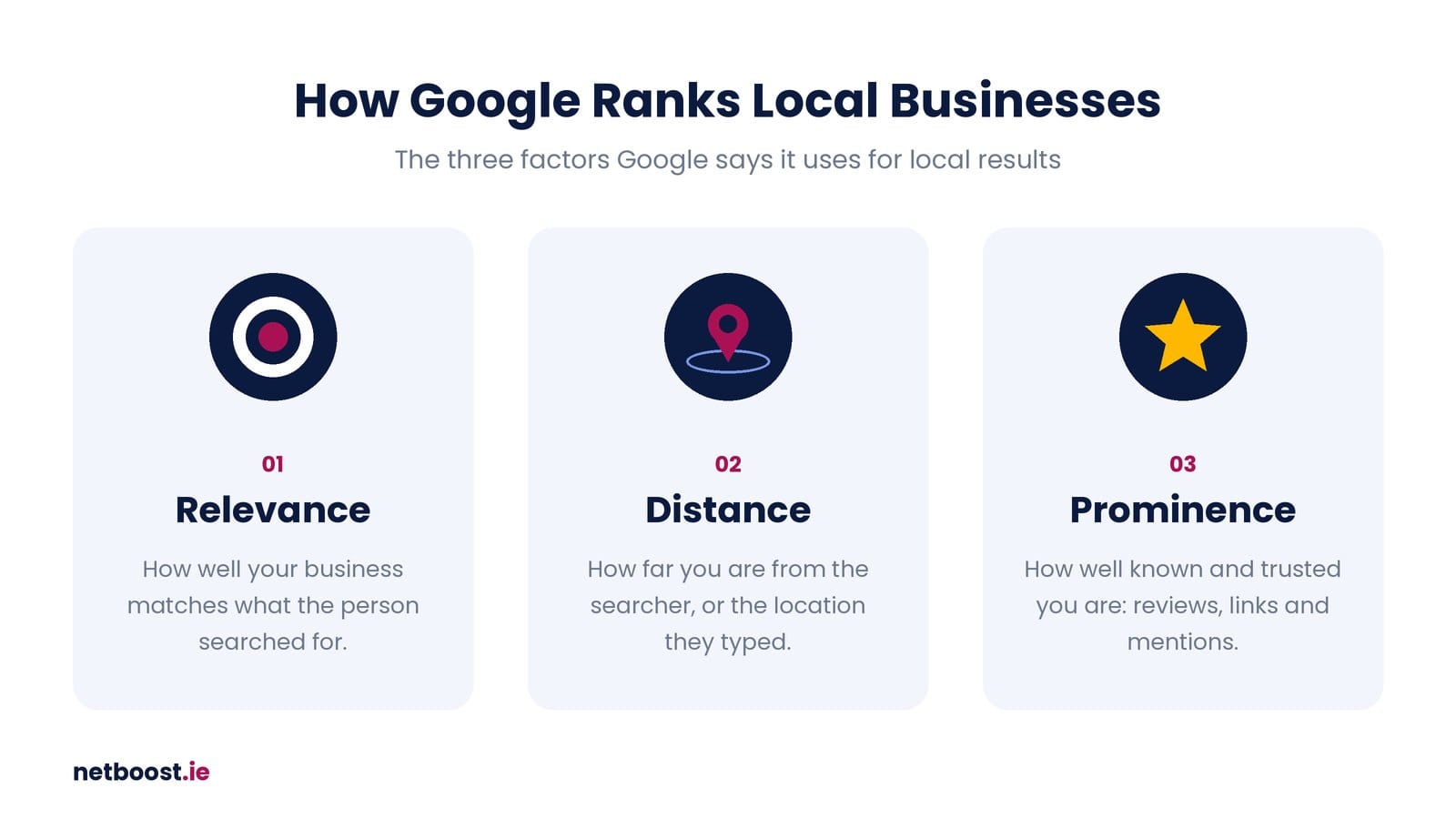
Google says it uses three main factors for local results:
- Relevance — how well your business matches what the person searched for
- Distance — how far you are from the searcher, or from the location they typed
- Prominence — how well known and trusted your business is, based on reviews, links, mentions and your overall web presence
You can't move your premises closer to every customer. But you can make a big difference to relevance and prominence — and that's where everything below comes in.
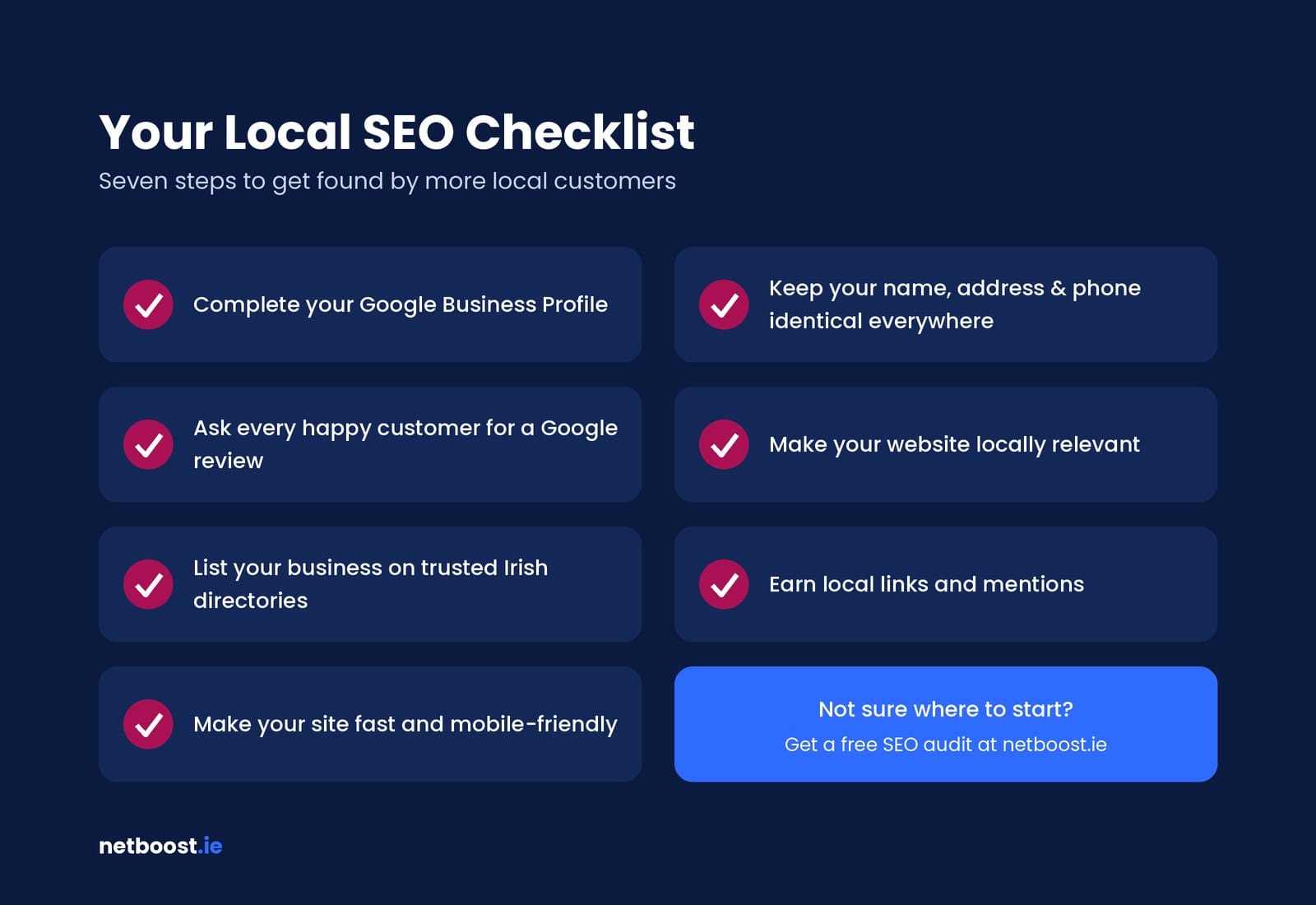
1. Claim and Complete Your Google Business Profile
Why it matters: Your Google Business Profile (formerly Google My Business) is the listing that appears in the map pack and Google Maps. It's free, and it's the single biggest lever in local SEO. Yet many Irish businesses have one that's half-finished, out of date, or was set up years ago by a nephew who has since emigrated.
What to do:
- Choose the right primary category. This is the most important field on the profile. Be specific — "Italian restaurant" beats "Restaurant", "Electrician" beats "Contractor". Add relevant secondary categories too
- Use your real trading name — no extra keywords stuffed in
- Add your full address with Eircode. It helps Google and customers pin you down exactly, which is especially useful in rural areas where addresses can be vague
- Set your service areas if you visit customers (tradespeople, mobile hairdressers, cleaners)
- Keep your hours accurate — including bank holidays. Nothing loses a customer faster than turning up on St. Patrick's Day to a locked door that Google said was open
- Upload real photos — your shopfront, team, work and premises. Stock images do very little here; people want to see who they're dealing with
- List your services or products with short descriptions
- Post regularly — offers, updates, new work, events. It shows Google and customers you're active
2. Keep Your Details Identical Everywhere
Why it matters: Google cross-checks your business information across the web. If your website says "Unit 4, Galway Business Park", Golden Pages says "4 Galway Bus. Pk", and Facebook still has your old mobile number, Google becomes less confident about which version is correct.
What to do: Aim for NAP consistency (Name, Address, Phone). Pick one exact format and use it everywhere — right down to whether you write "Co. Galway" or "County Galway", and whether your number appears as "085..." or "+353 85...". It's tedious work, but it's one of the easiest wins available.
3. Get More (Genuine) Google Reviews
Why it matters: Reviews help your ranking and persuade people to choose you. A business with 60 recent reviews averaging 4.8 stars will win the click over one with 4 reviews from 2019 almost every time.
What to do:
- Ask. Most happy customers never think to leave a review — ask in person at the end of a job, and add the request to your invoice or follow-up email
- Make it easy with the direct review link from your Business Profile. Turn it into a QR code for your counter
- Reply to every review — good and bad. A calm, professional reply to a one-star review often impresses potential customers more than the review itself puts them off
One warning: don't buy reviews, and don't offer discounts or freebies in exchange for them. That breaks Google's policies and can get reviews removed or your profile penalised. It isn't worth the risk.
4. Make Your Website Locally Relevant
Why it matters: Your Business Profile does a lot of the work, but Google also looks at your website to judge relevance.
What to do:
- Mention the towns and areas you serve naturally in your content — homepage, service pages, About page
- If you serve several locations, consider a dedicated page for each. Each one needs to be genuinely useful: local projects, local context, details specific to that area. Pages that copy the same text and swap "Cork" for "Limerick" are thin content — and Google knows it
- Put your full NAP and Eircode in your footer or contact page, ideally with an embedded Google Map
- Add LocalBusiness schema — structured data that tells search engines exactly who you are, where you are, and what areas you serve. Your web designer can set this up in under an hour
Not sure how your site measures up? Run it through our free SEO audit for an instant snapshot of what's working and what needs attention.
5. Build Irish Citations
Why it matters: A citation is any online mention of your business name, address and phone number. Accurate citations on trusted directories reinforce your location and legitimacy.
Where to get listed:
- Golden Pages
- Bing Places for Business (Bing is small in Ireland, but the listing takes minutes)
- Apple Business Connect — covers Apple Maps and Siri searches on iPhones
- Yelp
- Your local Chamber of Commerce directory
- Industry bodies and trade associations relevant to your work
The goal isn't hundreds of listings — it's a solid set of accurate, relevant ones that all match.
6. Earn Local Links and Mentions
Why it matters: Links and mentions from local websites strengthen your "prominence" in Google's eyes. This is where local SEO gets fun, because it rewards businesses that are genuinely part of their community.
What to do:
- Sponsor the local GAA club, a charity run or a school event — they'll usually link to you from their website
- Get featured in local media — the Galway Advertiser, the Connacht Tribune, local radio sites — through a story, an expert comment or an event
- Partner with complementary businesses — a wedding photographer and a florist can recommend each other
- Join local business networks and make sure your member profile links to your site
7. Don't Neglect Mobile and Speed
Why it matters: Most local searches happen on a phone — often on the move, often on patchy 4G. If your site takes eight seconds to load, that customer has already rung your competitor.
What to do: Check how your site performs using the tools in our guide to web speed testing tools, and make sure your phone number is tap-to-call on mobile. It sounds obvious, but a surprising number of sites still get it wrong. If you run an online shop, our guide on why your Shopify store isn't showing up on Google covers store-specific visibility issues too.
Common Local SEO Mistakes We See in Ireland
- Stuffing keywords into the business name — "Murphy's Plumbing Best Plumber Galway Cheap" can get your profile suspended
- Using a virtual office or PO box as your address — Google wants a real location or a properly set-up service area
- Duplicate listings for the same business, which split your reviews and confuse Google
- Setting up the profile once and forgetting about it — local SEO rewards businesses that stay active
- Ignoring reviews, especially the negative ones
How Long Does Local SEO Take?
Quick fixes — completing your profile, correcting categories, cleaning up your NAP — can make a difference within weeks. Building reviews, citations and local links takes longer: expect steady improvement over three to six months, and longer in competitive areas like Dublin city centre.
The good news is that local SEO compounds. Every review, citation and link keeps working for you long after you've earned it.
Frequently Asked Questions
Is local SEO worth it for a small business in Ireland?
Yes. For businesses that serve customers in a specific area, local search is often the biggest source of new enquiries. It's also one of the most cost-effective channels, because the core tools — like Google Business Profile — are free.
Do I need a website for local SEO?
You can appear in the map pack with just a Google Business Profile, but a good website strengthens your relevance, gives Google more to work with, and turns searchers into customers once they click through.
Can I do local SEO myself?
Absolutely — most of steps 1 to 3 are things any business owner can do. Many businesses bring in help for the technical side (schema, location pages, site speed) or when competing in a crowded market. A free SEO audit is a good place to start.
What's the difference between local SEO and regular SEO?
Regular SEO focuses on ranking for topics nationally or globally. Local SEO focuses on ranking for searches tied to a specific place, and on appearing in Google Maps and the map pack.
Want to Get Found by More Local Customers?
Most of the steps above cost nothing but a little time. But if you're competing in a crowded local market — or you'd simply rather spend your evenings running your business than tweaking your Google profile — that's where we come in.
At Netboost, we help Irish businesses show up where it counts: in the map pack, in local search, and in front of customers ready to buy. Start with a free SEO audit to see where you stand, explore our SEO services, or book a free consultation and call us on +353 85 733 1516.
Related Posts
Local SEO for Small Businesses in Ireland: A Beginner's Guide
September 29, 2026
AI in Web Design and SEO: Current Trends
February 4, 2025